
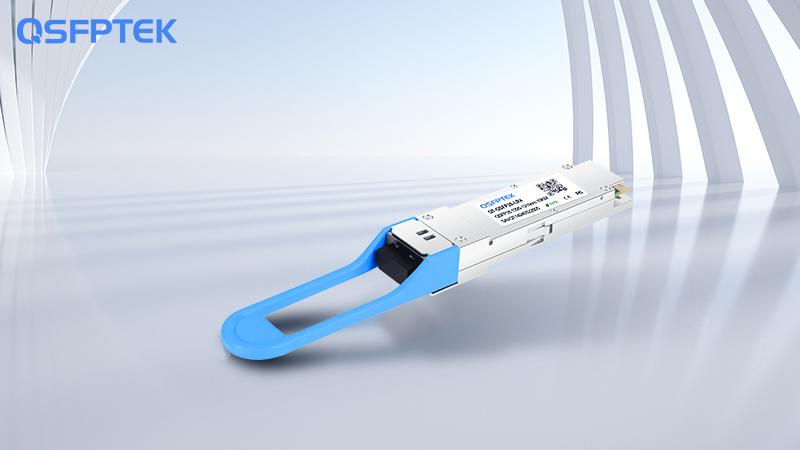

The Role of 25GBASE-LR in Today’s Network Hierarchies
In many modern network designs, the speed gap between access and core used to be huge. You might see 1G at the edge and 100G in the backbone, with 10G acting as a thin middle layer. 25GBASE-LR is changing that balance. It gives the access and aggregation layers a lot more breathing room without dragging the cost and complexity of full 100G everywhere.
At its core, 25GBASE-LR is simple: a 25 Gbps Ethernet link over single-mode fiber with up to 10 km of reach. It uses the SFP28 form factor and usually operates around 1310 nm. Nothing exotic, nothing difficult to understand — just more speed on a very familiar optical platform.
Why Long-Reach 25G Matters in Distributed Networks
Distributed networks are everywhere now. Campuses with remote buildings, hospitals with multiple wings, industrial sites with production halls and control rooms, logistics centers with wide footprints — all of them rely on long fiber runs. In these environments, short-reach multimode optics simply won’t work.
25GBASE-LR allows these sites to carry far more traffic over the same fiber paths that used to carry 10G. Video systems, industrial sensors, centralized control platforms, and cloud-connected workloads all benefit from that extra headroom. And because it stays within the 10 km class, it avoids the higher cost and higher power of extended-reach optics.
Transitioning from 10G to 25G with Minimal Disruption
One of the biggest advantages of 25GBASE-LR is how gently it fits into existing designs. Many switches now ship with ports that can operate as 10G or 25G depending on the transceiver. This allows phased upgrades: keep part of the network at 10G while migrating the busiest links to 25G.
From an operational standpoint, this flexibility is extremely valuable. You don’t need a “big bang” migration. You can upgrade link by link, building by building, or rack by rack. During that process, the same single-mode fiber, patch panels, and routes remain in use.
25GBASE-LR in Data Centers and Edge Computing
In data centers, 25GBASE-LR often appears where distance slightly exceeds what 25G SR can handle. For example, inter-building data centers, remote backup facilities, or disaster recovery sites frequently sit a few kilometers apart. In those cases, 25G LR provides just enough reach with much lower cost than assembling a 100G optical path.
Edge computing environments also benefit. Small regional data centers often need to push large volumes of data back to a central site, but they don’t always need 100G pipes. 25G LR gives them strong uplinks while keeping equipment sizes and costs reasonable.
Power Efficiency and Thermal Stability
As networks scale out, power and cooling become limiting factors. Compared with 100G optics, 25GBASE-LR has a clear advantage in energy efficiency at the access layer. Lower per-port power means more ports per switch without hitting thermal limits. That allows for denser, more compact designs — something that matters a lot in edge sites with limited rack space.
Thermal stability also improves reliability. Modules that run cooler usually fail less often over their lifetime. That’s not always visible in spec sheets, but it’s very noticeable in long-term operations.
Interoperability, Supply, and Cost Trends
By now, 25GBASE-LR is widely supported across the networking industry. You can source SFP28 LR modules from most major vendors as well as third-party suppliers. This competition has driven prices down to a level where 25G is no longer seen as “premium.” In many regions, the price gap between 10G LR and 25G LR is shrinking every year.
For purchasing and inventory teams, this availability is important. It reduces the risk of supply shortages and gives more freedom to negotiate cost and delivery schedules.
Conclusion
25GBASE-LR is quietly redefining what “normal” looks like at the access and aggregation layers. It delivers significantly more bandwidth than 10G, keeps long-reach capability on single-mode fiber, and avoids the operational and financial weight of pushing 100G everywhere. For campuses, data centers, carrier access networks, and edge computing sites, 25GBASE-LR has become a very natural step forward — not driven by hype, but by steady, real demand.